
Reduce Absenteeism with GoHighLevel Tools
Education Technology, Student Attendance, GoHighLevel
How Teachers Can Use GoHighLevel Pipelines, Opportunities, and Workflows to Reduce Chronic Absenteeism and Tardiness
Chronic absenteeism is one of the most stubborn barriers to learning, but teachers now have access to powerful CRM-style tools to track, communicate, and intervene before students slip through the cracks. GoHighLevel’s pipelines, opportunities, and workflows can help you turn attendance data into timely, relationship-centered action.
Why Attendance Needs a “CRM Mindset”
Research from the Institute of Education Sciences (IES) is clear: schools that use early warning systems and tiered supports are more successful at reducing chronic absenteeism than those relying on end-of-term reports alone. At the same time, evidence-backed strategies like personalized text nudges to families have reduced chronic absenteeism by 12–18% in some studies (IES, 2026). GoHighLevel (GHL), originally built for businesses, now gives educators a practical way to bring these same data-driven, communication-rich strategies into the classroom.
With its CRM, automation, and AI-native tools, GHL lets teachers treat attendance like a student success pipeline—not just a number on a report. Instead of manually chasing down every absence, you can design a system that flags concerns, sends the right message to the right family, and helps you focus on relationship-building and instruction.
Step 1: Build an Attendance Pipeline That Mirrors Tiered Supports
In GoHighLevel, a pipeline is a visual board that shows where each “opportunity” is in a process. For teachers, each opportunity can represent a student’s attendance status. Align your pipeline stages with the multi-tiered model recommended by IES:
Tier 1 – On Track: Students with strong attendance (missing <5% of days).
Tier 2 – At Risk: Students with emerging patterns of absence or frequent tardiness.
Tier 3 – Chronically Absent: Students missing 10% or more of instructional days.
Once your pipeline is created, each student becomes an opportunity card. You can drag students between stages as their attendance improves or worsens, or use automation to move them based on data imports or manual triggers. This gives you a live “early warning” board that matches the tiered systems promoted by IES and state-level frameworks like NJTSS and AttendNC.
💡 Pro Tip: Add custom fields to each opportunity for key details: primary caregiver contact, transportation notes, known health issues, and preferred communication language. This makes every outreach more respectful and effective.
Step 2: Use Opportunities to Coordinate Real Interventions, Not Just Reminders
Each opportunity in GoHighLevel can store notes, tasks, and communication history. That makes it ideal for coordinating the kind of relationship-based supports that CASEL and the U.S. Department of Education emphasize over punitive approaches.
Log home visits, counselor meetings, or restorative conversations as notes on the student’s card, so the team sees a full story, not just a number.
Assign follow-up tasks—like “call caregiver by Friday” or “check in with student during advisory”—and track completion directly from the pipeline.
Use GHL’s unified conversations to see texts, emails, and calls in one place, making it easier to coordinate with family liaisons or support staff.
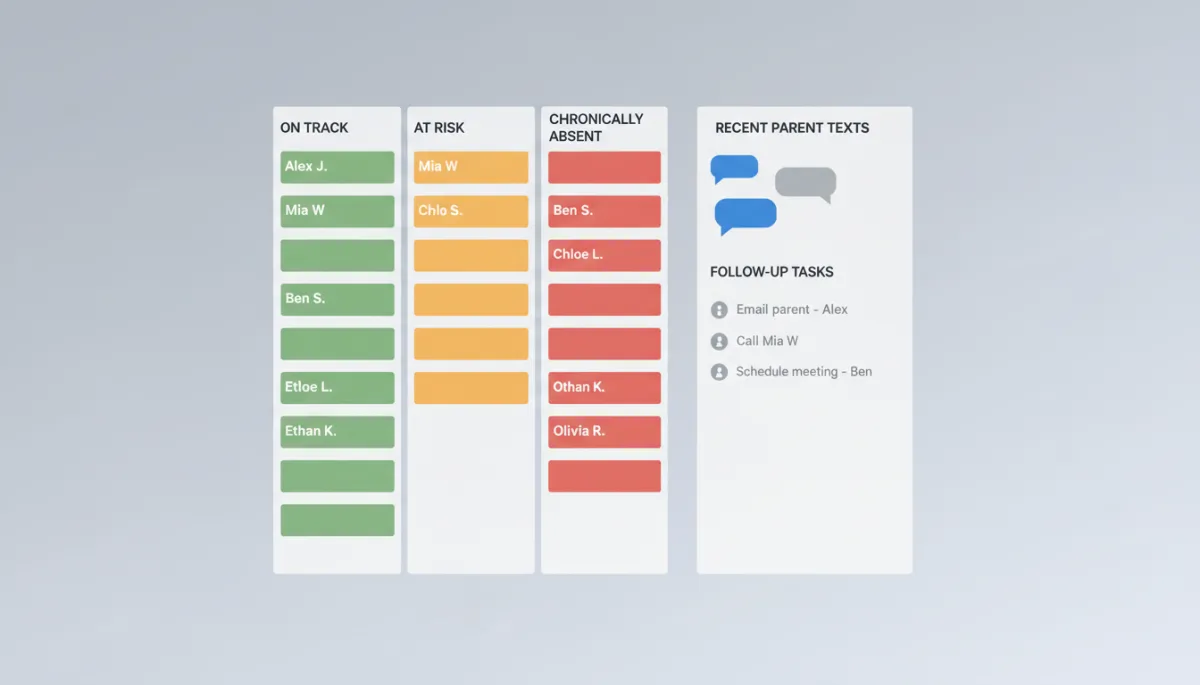
A simple attendance pipeline helps staff coordinate outreach and track every contact.
Step 3: Automate Evidence-Based Communication With Workflows
GoHighLevel’s workflows let you design automated sequences that trigger when a student’s attendance changes. This is exactly where you can implement the “nudge” strategies that research shows are effective—without adding hours to your day.
Same-day absence alerts: When a student is marked absent, trigger a friendly text to caregivers: “We missed Jordan today. Is everything okay? Remember, even a few absences can add up.”
Tardiness follow-up: After three tardies in a week, send a short check-in and invite caregivers to share barriers like transportation or morning routines.
Positive reinforcement: When a student moves from “At Risk” back to “On Track,” send a celebratory message to both student and caregiver to reinforce the habit.
In 2026, GoHighLevel also includes advanced Workflow AI and an AI Employee suite. You can use these tools to:
Draft empathetic, plain-language messages in multiple languages, aligned with your school’s tone and equity commitments.
Summarize call outcomes so staff can see at a glance what was discussed and what next steps are needed.
📌 Key Takeaway: Automations should feel human, not robotic. Use AI to handle the routine parts (timing, templates, translation) so you can focus on listening, problem-solving, and building trust.
Step 4: Turn Attendance Data Into Continuous Improvement
Federal guidance and state initiatives—from New Jersey’s NJTSS pathways to North Carolina’s AttendNC guide—stress the importance of regularly reviewing and disaggregating attendance data. GoHighLevel’s reporting dashboard lets you:
Monitor how many students sit in each pipeline stage over time.
Track which workflows (texts, calls, home visits) correlate with improved attendance.
Share simple, visual summaries with school leadership teams or district collaboratives focused on reducing chronic absenteeism.
Instead of waiting for end-of-year state reports, your team can adjust strategies monthly or even weekly—aligning your work with national best practices and local initiatives like the Reducing Chronic Absenteeism Collaborative launched in 2026.
Try It Safely: Experiment in the Educator Innovation Sandbox Implementation Lab
If you’re new to GoHighLevel, you don’t have to figure this out alone—or risk breaking anything in your live school systems. The Educator Innovation Sandbox Implementation Lab is a guided, low-pressure space where you can:
Build a sample attendance pipeline and test different stages and labels.
Practice setting up workflows for absence alerts, tardy follow-ups, and celebration messages.
Get feedback on message tone, family engagement strategies, and data privacy considerations from experienced facilitators.
Ready to experiment with a real attendance pipeline before rolling it out to your team? Educator Innovation Sandbox Implementation Lab – Learn More & Enroll
Get Started With GoHighLevel: 14-Day Free Trial for Educators
GoHighLevel’s 2026 feature set—CRM, pipelines, AI-enhanced workflows, unified messaging, and robust reporting—was built for complex relationship management. That makes it surprisingly well-suited to the challenge of chronic absenteeism, where every student’s story is unique and every day counts.
You can explore the platform, build your first attendance pipeline, and test automated communication sequences with a GoHighLevel 14-Day Free Trial. No long-term commitment—just a chance to see how a modern CRM can support the evidence-based strategies your school is already pursuing. Start Your GoHighLevel 14-Day Free Trial
💬 Next Step: Pair your free trial with the Educator Innovation Sandbox Implementation Lab so you’re designing your attendance system with expert guidance from day one.
Final Thoughts: Technology as a Partner in Attendance, Not a Replacement for Relationships
The most successful efforts to reduce chronic absenteeism—whether through text nudges, home visits, or SEL-rich classrooms—share a common theme: students feel seen, supported, and connected. GoHighLevel will not solve attendance challenges on its own, but it can take the heavy lifting out of tracking patterns, sending timely messages, and coordinating adult responses.
By combining GHL pipelines, opportunities, and workflows with the research-backed strategies endorsed by IES, CASEL, and national collaboratives, teachers can reclaim time, respond earlier, and keep more students in class—where they belong.